Friday, October 30, 2015

What are autoencoders and stacked autoencoders?

An encoder is a function  which transforms the input vector  in the output  where  is a weight matrix and  is an offset vector. A decoder is an inverse function which tries to reconstruct the original vector from y. An auto-encoder tries to reconstruct the original input by minimizing the error during the reconstruction process. There are two major variants for auto-encoding: Sparse auto-encoders force sparsity by using L1 regularization, while de-noising autoencoders stochastically corrupt the input with some form of randomization.
Mathematically, a stochastic mapping transforms the input vector  into a noisy vector  which is then transformed into an hidden representation . The reconstruction phase is via a decoder  where an error minimization algorithm is used via either squared error loss or cross-entropy loss. Autoencoders typically use a hidden layer which acts as a bottleneck that compress the data as in figure.


In a deep learning context, multiple auto-encoder are stacked for producing the final denoised output. The “magic” outcome of this combination is that autoencoders learn how to extract meaningful features from noise data with no need offhand-craft features’ selection. There are also additional applications. For instance, deep autoencoders are able to map images into compressed vectors with small dimensionality and this can be useful for searching images by image similarity. Plus, Deep autoencoders can map words into small dimension vectors and this is a process useful in topic modelling  distributed across a collection of documents.

Thursday, October 29, 2015

Academic Search and Relevance on ScienceDirect

During the past few months team worked on Academic Search. So, it is time to post a number of side- by-side comparisons. Let's select a topic.. say Modern Finance and pick a few queries just to show where we are.

{quantitative easing}


All articles are from 2010/2011, while here instead we show fresh results which are more relevant


{ultrafast trading}


here there is a proximity match and an alteration problem since ultrafast trading actually means high-frequency trading and it is not that fast to give a result of 1999. ScienceDirect correctly nails it


{fintech}


Fintech has a very specific meaning in Finance and this meaning is not nailed. ScienceDirect got it and it is also fresh. Kinda of cool.


Please run your own queries and report SATs and DSATs. Search and Relevance requires continuous investments and the work is never really done. There is always a metric to move, and new learnings to apply - which is why the job is fun!!

Antonio Gulli

Wednesday, October 28, 2015

What is Deep Learning?

Deep Learning is a buzzword which entered the mainstream thanks to some recent results capturing the attention of a global audience. Google’s Brain project learns to finds cats in videos, Facebook recognizes faces in images, Baidu recognizes visual shapes and objects, and both Baidu and Microsoft use deep learning for speech recognition. Apart from buzzwords, the most prestigious minds are world-wide working in deep learning including Jeff Dean (Google), Yann LeCun(Facebook), Andrew Ng(Baidu).

One very interesting progress made with Deep Learning is that it is now possible to learn how to extract discriminative features in an automatic way. Instead, traditional machine learning requires a lot of human effort for hand-crafting features and the machine learning was essentially a way to learn weights for balancing those features. Automatically discovering of discriminative features is indeed a big step forward toward reasoning. Machines can now learn what is important and what is not, while before humans had to pick features which were potentially important and, then, let the machines weight them at the risk of missing discriminative and fundamental information simply because it was not considered. In short, we can say that now we have Trainable Feature Extractors and Trainable Learning while before we only had the former. Auto-encoders are one tool used by Deep Learning for finding features useful for representing an input distribution.

Another interesting characteristic of Deep Learning is the ability to learn from mostly unlabelled data in a typical semi-supervised learning setting where a very large number of training examples are not having complete and correct true labels.
Yet another interesting trait of Deep Learning is the ability to learn how to approximate highly varying functions which happens when a piecewise approximation (with constant or linear pieces) of a function requires a very large number of pieces.

Deep learning uses a cascade of many layers of non linear processing units which performs feature extraction and transformation. What is still required is to compose manually the layers according the specific problem to be solved. So, the big next step would be to learn how to self-organize layers. Typically, Deep Learning compose many (recurrent) layers of ANNs with even more sophisticated generative models such as Deep Belief Networks and Deep Bolzmann Machines.
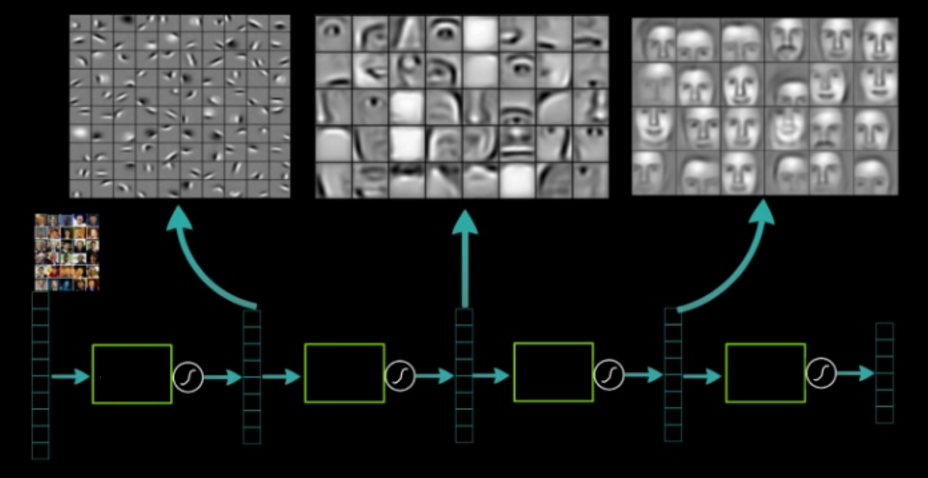
One fundamental assumption is that each level will learn more abstract concepts of the previous level. This concept is well explained in this image where the first layer learns basic features, while the second layer learns components of human face, and the third layer learns different types of faces. Hence, the learning system is a high dimensional entity able to discriminate many observed features that are related by unknown statistical relations. The learning is distributed in the sense that the the knowledge itself is not associated with one single neuron but it is the result of sharing the information within the network and the consequent activation of multiple neurons.

As shown in this image, the features become more extended and complex deeper in the network. In addition to that, multiple networks can be specialized on different concepts and learn how faces, cars, elephants, and chairs are visualized.

Advances in hardware have also been an important enabling factor for Deep Learning. In particular, powerful graphics processing units (GPUs) are highly suited for matrix and vector operations involved in machine learning and GPUs can speed up training algorithms by orders of magnitude, bringing running times of weeks back to few hours. This allows to increase the number of layers in a deep network and therefore the level of sophistication in representing models. This image gives another idea of how different levels are progressively learning more and more complex visual features.


Deep Learning network are typically trained via backpropagation where weights are updated via Stochastic Gradient Descent using an equation such as
 

so that the weight between the units  is updated at time  based on the weight available at time t plus a fraction of the partial derivative of a chosen cost function.  is the learning rate. Google built an Asynchronous Distributed Stochastic Gradient Descent server where more than 16000 CPUs independently update the gradient weights for learning the rather sophisticate recognition of the concept of “cats” from a generic YouTube video.  Other types of training have been proposed including forward propagation and forward-backward propagation for Restricted Bolzmann Machines and for Recurrent Networks.      
Another rather sophisticate approach uses Convolutional networks (networks where the same weight is used in all the spatial locations in the layer) with 24 layers for annotating images with concepts showing an impressive 6.6% error rate at top 5 results, which is a result competitive with the human brain.[1]


Embedding is another key concept introduced by Deep Learning. Embedding is used to avoid the problems encountered when learning with sparse data. For instance, we can extract words from documents and then create words embedding where words are simply grouped together if they occur within a chosen text window. A word embedding  : is a parameterized function mapping words in some language to high-dimensional vectors (perhaps 200 to 500 dimensions). Embedding vectors trained for language modelling task have very interesting proprieties where it is possible to express concepts and equivalences such as the relations between capitals and countries, and the relation between the queen and the king, and the meaning of superlative[2]
This table describe a word embedding learned on a skip model trained on 783M words with 300 dimensionalities        

If you are interested in knowing more about Deep Learning, then it could be worth having a look to a very exciting keynote by the way of Andrew Ng[3]. The author of this book strongly believes that the next step for Deep Learning is to integrate progress in HPC computation (where Spark is) with GPU computation (where packages like Theano and Lasagne are). This will open the root on deep learning cloud computation also leveraging the power of GPU platforms like CUDA.[4]

Tuesday, October 27, 2015

Collection of DataScience - volume 2


TOC

1. Why is Cross Validation important? 12
Solution 12
Code 12
2. Why is Grid Search important? 13
Solution 13
Code 13
3. What are the new Spark DataFrame and the Spark Pipeline? And how we can use the new ML library for Grid Search 14
Solution 14
Code 15
4. How to deal with categorical features? And what is one-hot-encoding? 17
Solution 17
Code 18
5. What are generalized linear models and what is an R Formula? 18
Solution 18
Code 19
6. What is the Word2Vec distributed representation? 19
Solution 19
Code 20
7. What are the Decision Trees? 20
Solution 20
Code 22
8. What are the Ensembles? 23
Solution 23
9. What is a Gradient Boosted Tree? 23
Solution 23
10. What is a Gradient Boosted Trees Regressor? 24
Solution 24
Code 24
11. Gradient Boosted Trees Classification 25
Solution 25
Code 25
12. What is a Random Forest? 27
Solution 27
Code 27
13. What is an AdaBoost classification algorithm? 28
Solution 28
14. What is a recommender system? 29
Solution 29
15. What is a collaborative filtering ALS algorithm? 29
Solution 29
Code 30
16. What is the DBSCAN clustering algorithm? 31
Solution 31
Code 31
17. What is a Streaming K-Means? 32
Solution 32
Code 33
18. What is the PCA Dimensional reduction technique? 33
Solution 33
Code 35
19. What is the SVD Dimensional reduction technique? 35
Solution 35
Code 36
20. What is Parquet? 36
Solution 36
Code 36
21. What is the Isotonic Regression? 37
Solution 37
Code 37
22. What is SVM with soft margins? 38
Solution 38
23. What is the Expectation Maximization Clustering algorithm? 39
Solution 39
24. What is a Gaussian Mixture? 40
Solution 40
Code 41
25. What is the Latent Dirichlet Allocation topic model? 41
Solution 41
Code 42
26. What is the Associative Rule Learning? 43
Solution 43
27. What is FP-growth? 44
Solution 44
Code 44
28. How to use the GraphX Library? 45
Solution 45
29. What is PageRank? And how to compute it with GraphX 46
Solution 46
Code 47
Code 47
30. What is Power Iteration Clustering? 48
Solution 48
Code 49
31. What is a Perceptron? 49
Solution 49
32. What is an ANN (Artificial Neural Network)? 50
Solution 50
33. What are the activation functions? 51
Solution 51
34. How many types of Neural Networks are known? 52
35. How can you train a Neural Network 53
Solution 53
36. What application have the ANNs? 54
Solution 54
37. Can you code a simple ANNs in python? 55
Solution 55
Code 55
38. What support has Spark for Neural Networks? 57
Solution 57
Code 57
39. What is Deep Learning? 58
Solution 58
40. What are autoencoders and stacked autoencoders? 62
Solution 62
41. What are convolutional neural networks? 63
Solution 63
42. What are Restricted Boltzmann Machines, Deep Belief Networks and Recurrent networks? 64
Solution 64
43. Neural Network – Deep Learning - Theano 66
Solution 66
Code 66
Complexity 66
44. Neural Network – Deep Learning - Theano 66
Solution 66
Code 67
Complexity 67
45. Neural Network – Deep Learning - Lasagne 67
Solution 67
Code 67
Complexity 67
46. Splines 67
Solution 67
Code 67
Complexity 67
47. Search – Hill Climbing, Simulated Annealing, Greedy 67
Solution 67
Code 67
Complexity 67
48. MonteCarlo 67
Solution 67
Code 68
Complexity 68
49. Sampling (Gibbs) 68
Solution 68
Code 68
Complexity 68
50. Hypothesis Testing 68
Solution 68
Code 68
Complexity 68
51. Text Mining 68
Solution 68
Code 68
Complexity 68
52. NLP tagging 68
Solution 68
Code 69
Complexity 69
53. Bloom Filters 69
Solution 69
Code 69
Complexity 69
54. minHash 69
Solution 69
Code 69
Complexity 69
55. LSH 69
Solution 69
Code 69
Complexity 69
56. Count Min Sketches 69
Solution 69
Code 69

Monday, October 26, 2015

A collection of Data Science Interview Questions Solved in Python and Spark: Hands-on Big Data and Machine Learning


TOC

1. What are the most important machine learning techniques? 10
Solution 10
2. Why is it important to have a robust set of metrics for machine learning? 11
Solution 11
Code 12
3. Why are Features extraction and engineering so important in machine learning? 12
Solution 12
4. Can you provide an example of features extraction? 14
Solution 14
Code 14
5. What is a training set, a validation set, a test set and a gold set in supervised and unsupervised learning? 15
Solution 15
6. What is a Bias - Variance tradeoff? 16
Solution 16
7. What is a cross-validation and what is an overfitting? 17
Solution 17
Code 18
8. Why are vectors and norms used in machine learning? 18
Solution 18
Code 19
9. What are Numpy, Scipy and Spark essential datatypes? 19
Solution 19
Code 20
10. Can you provide an example for Map and Reduce in Spark? (Let’s compute the Mean Square Error) 20
Solution 20
Code 21
11. Can you provide examples for other computations in Spark? 22
Solution 22
Code 25
12. How does Python interact with Spark 26
Solution 26
13. What is Spark support for Machine Learning? 26
Solution 26
14. How does Spark work in a parallel environment 27
Solution 27
Code 27
15. What is the mean, the variance, and the covariance? 27
Solution 27
Code 28
16. What are percentiles and quartiles? 28
Solution 28
Code 28
17. Can you transform an XML file into Python Pandas? 29
Solution 29
Code 29
18. Can you read HTML into Python Pandas? 30
Solution 30
Code 30
19. Can you read JSON into Python Pandas? 31
Solution 31
Code 31
20. Can you draw a function from Python? 31
Solution 31
Code 31
21. Can you represent a graph in Python? 32
Solution 32
Code 32
22. What is an Ipython notebook? 33
Solution 33
Code 33
23. What is a convenient tool for performing data statistics? 34
Solution 34
Code 34
24. How is it convenient to visualize data statistics 35
Solution 35
Code 35
25. How to compute covariance and correlation matrices with pandas 36
Solution 36
Code 36
26. Can you provide an example of connection to the Twitter API? 37
Solution 37
Code 37
27. Can you provide an example of connection to the LinkedIn API? 39
Solution 39
Code 39
28. Can you provide an example of connection to the Facebook API? 39
Solution 39
Code 40
29. What is a TFxIDF? 40
Solution 40
Code 40
30. What is “features hashing”? And why is it useful for BigData? 41
Solution 41
31. What is “continuous features binning”? 42
Solution 42
32. What is an LP normalization? 42
Solution 42
Code 42
33. What is a Chi Square Selection? 42
Solution 42
34. What is mutual information and how can it be used for features selection? 43
Solution 43
35. What is a loss function, what are linear models, and what do we mean by regularization parameters in machine learning? 43
Solution 43
36. What is an odd ratio? 46
37. What is a sigmoid function and what is a logistic function? 46
Code 47
38. What is a gradient descent? 47
Solution 47
39. What is a stochastic gradient descent? 49
Solution 49
Code 49
40. What is a Linear Least Square Regression? 50
Solution 50
Code 51
41. What are Lasso, Ridge, and ElasticNet regularizations? 52
Solution 52
42. What is a Logistic Regression? 52
Solution 52
Code 53
43. What is a stepwise regression? 54
Solution 54
44. How to include nonlinear information into linear models 54
Solution 54
45. What is a Naïve Bayes classifier? 55
Solution 55
46. What is a Bernoulli and a Multivariate Naïve Bayes? 57
Solution 57
Code 58
47. What is a Gaussian? 59
Solution 59
Code 59
48. What is a Standard Scaling? 60
Solution 60
Code 60
49. Why are statistical distributions important? 61
Solution 61
Code 63
50. Can you compare your data with some distribution? What is a qq-plot? 63
Solution 63
Code 63
51. What is a Gaussian Naïve Bayes? 64
Solution 64
52. What is another way to use Naïve Bayes with continuous data? 64
Solution 64
53. What is the Nearest Neighbor classification? 65
Solution 65
Code 66
54. What are Support Vector Machines (SVM)? 66
Solution 66
Code 68
55. What are SVM Kernel tricks? 68
Solution 68
56. What is K-Means Clustering? 70
Solution 70
Code 71
57. Can you provide an example for Text Classification with Spark? 71
Solution 71
Code 71
58. Where to go from here 72
Appendix A 75
59. Ultra-Quick introduction to Python 75
60. Ultra-Quick introduction to Probabilities 76
61. Ultra-Quick introduction to Matrices and Vectors 76

Sunday, October 25, 2015

AntonioGulli.com

A new web site

http://www.antoniogulli.com/ 

Antonio Gulli 

Computer Scientist
Pisa, Amsterdam, London, NYC

Nowadays you must have a great combination of research skills and just-get-it-done attitude.

Patents
20. POPULATION AND/OR ANIMATION OF SPATIAL VISUALIZATION(S)
United States 9,009,159

Issued April 14, 2015

One or more techniques and/or systems are provided for populating and/or animating a spatial visualization, such as a map, a timeline, and/or other 2D and/or 3D visual representations of locations. The spatial visualization may be populated with events extracted from a data source (e.g., real-time events, news events, social network events, etc.), and may include relationships between events (e.g....more

3 inventors:
Antonio Gulli
Vice President at RELX Group
Daniel Bernhardt
Software Engineer at Facebook
michael kaisser

19. Sampling internet user traffic to improve search resultsUnited States 8046357

Issued October 25, 2011

Methods, systems and apparatus for improving the freshness, the coverage, the ranking and the clustering of search engine results are described. According to one aspect of the invention, a method includes monitoring network activity on a communications network, generating a near real-time map of the network activity and integrating the near real-time map of the network activity with a search engine.

3 inventors:
Antonio Gulli
Vice President at RELX Group
Monica Mori
Tiscali Italia S.p.A. at Tiscali
Antonio Savona
Information Analytics Expert, Vice President at Swiss Re

18. Similarity detection and clustering of images
United States 7,801,893

Issued September 21, 2010

A system and method for determining if a set of images in a large collection of images are near duplicates allows for improved management and retrieval of images. Images are processed, image signatures are generated for each image in the set of images, and the generated image signatures are compared. Detecting similarity between images can be used to cluster and rank images.

3 inventors:
Antonio Gulli
Vice President at RELX Group
Antonio Savona
Information Analytics Expert, Vice President at Swiss Re
Filippo Tanganelli
s at List SpA

17. Method and system to present video contentUnited States 7,730,405

Issued June 1, 2010

A method and system to preview video content. The system comprises an access component to receive a search request and a loader to simultaneously stream a plurality of videos associated with the search request. The system may further comprise a trigger to detect a pointer positioned over a first video and a mode selector to provide the first video in a preview mode

3 inventors:
Antonio Gulli
Vice President at RELX Group
Antonio Savona
Information Analytics Expert, Vice President at Swiss Re
Mario Veri
Co-Founder at Salesoar

16. System and Methods for monitoring and reducing the consumption of electricity with a network of smart sensorsUnited States 14/448489

Filed July 31, 2014

The present invention relates to a system and method for monitoring and reducing consumption of electricity with a network of smart sensors connected to either electrical devices, electronic devices and/or lights

3 inventors:

Antonio Gulli
Vice President at RELX Group
Gulli
Gullis

15. PROVIDING WEB-BASED ALTERNATE TEXT OPTIONS
United States 20140379324

Filed December 25, 2014

Systems, methods, and computer-readable storage media are provided for mining web content for synonyms for selected words and/or phrases and presenting such web-based synonyms in the context of applications that permit text editing. As the synonyms are mined from web content, they have potentially more expansive and accurate coverage than a fixed, and often dated, thesaurus. Web content for...more

2 inventors:
Antonio Gulli
Vice President at RELX Group
Ioannis Klapaftis
Senior Applied Scientist at Microsoft

14. INTENT-AWARE KEYBOARD
United States 20140379744

Filed December 25, 2014

Systems, methods, and computer storage media having computer-executable instructions embodied thereon that provide contextual services are provided. Embodiments of the present invention allow an input mechanism to provide contextual services. Exemplary input mechanisms include a keyboard, a gesture interface, and a speech interface. These inputs may be used to provide user input into one or more...more

3 inventors:
Antonio Gulli
Vice President at RELX Group
Kuansan Wang
Director, ISRC/CSRC at Microsoft
Yu-Ting Kuo
Simply a product guy ...

13. TAGGING DIGITAL CONTENT WITH QUERIES
United States 20140279994

Filed September 18, 2014

Digital content can be annotated with a query. Upon selection of the query, a search can be initiated on a search engine with the query and search results relevant to the query are returned. Suggestions can be provided automatically in conjunction with query insertion. Suggestions can be supplied as a function of an input fragment and past search engine queries, among other things.

2 inventors:
Antonio Gulli
Vice President at RELX Group
gulli

13. SEARCH ANNOTATION AND SUGGESTION
United States 20140280297

Filed September 18, 2014

Digital content can be annotated with a search annotation. A user can specify or otherwise identify one or more terms, comprising a query, in conjunction with an annotation signal, for example. Suggestions can be provided automatically to aid a user in specifying the terms, among other things. Furthermore, a hyperlink can be generated that targets a search engine with the query or some other...more

2 inventors:
Antonio Gulli
Vice President at RELX Group
Arun Mehta
Principal Program Manager Lead at Microsoft UK Ltd

12. Intent-Based Presentation of Search Results
United States 20140136536

Filed May 15, 2014

Various embodiments of the disclosed subject matter include computer-implemented methods, computer-readable media, and computer systems configured to respond to a search query from a computer user. In response to receiving a search query from the computer user, search results are obtained. A plurality of user intents are identified according to the obtained search results. The obtained search...more

(Open)5 inventors, including:
Antonio Gulli
Vice President at RELX Group
Bill Ramsey
Partner Architect at Microsoft
Nitin Agrawal
Simant Dube,

11. Clarifying User Intent of Query Terms of a Search Query
United States 20140279993

Filed March 14, 2013

Systems and methods for clarifying a computer user's intent with regard to one or more query terms of a search query are presented. Often, one or more query terms of a search query are ambiguous and/or unclear. As presented herein, upon identifying a query term in the search query that is unclear, clarification data is obtained and presented to the computer user by way of a clarification user...more

4 inventors:
Antonio Gulli
Vice President at RELX Group
Daniel Bernhardt
Software Engineer at Facebook
Rui Ferreira
Software Engineer at Facebook
Elbio Abib
Principal Group Engineering Manager at Microsoft

9. STORYLINE VISUALIZATIONUnited States 20130157234

Filed December 14, 2011

One or more techniques and/or systems are disclosed for constructing a storyline visualization. The storyline visualization may be constructed from one or more temporal documents (e.g., news stories having publication dates). The temporal documents may be organized into chapters, subchapters, and/or various storylines interconnected by branches. In this way, the storyline visualization may relate...more

4 inventors:
Antonio Gulli
Vice President at RELX Group
Giovanni P. Deretta
Vice President at JPMorgan Chase & Co.
Antonio Savona
Information Analytics Expert, Vice President at Swiss Re
Daniel Bernhardt
Software Engineer at Facebook

8. System and Methods for Classifying Answers such as URLs
United States 20090157640

Filed June 18, 2009

The invention provides a computer system, including a memory, a plurality of answers stored in the memory, and a classifier for matching each one of the answers with a category among a plurality of categories.

(Open)5 inventors, including:
Antonio Gulli
Vice President at RELX Group
Maurizio Sambati
Co-Founder at Viralize Media
Alessio Signorini
Technologist
Alessandro Arzilli
Senior Search Engineer at OneRiot

7. Systems and methods for clustering information
United States 20090070346

Filed March 12, 2009

Systems and methods for clustering news information are disclosed. The news information is clustered to form clusters to include one or more of articles, blogs, images, videos and the like. The news information is organized according to topic and/or temporal information. The clustered news information can be presented to a user who can browse or search the clustered news information.

3 inventors:

Antonio Gulli
Vice President at RELX Group
Antonio Savona
Information Analytics Expert, Vice President at Swiss Re
Giovanni P. Deretta
Vice President at JPMorgan Chase & Co.

6. Systems and methods for personalizing a newspaper
United States 20080262998

Issued October 23, 2008

Systems and methods for presenting news information and personalizing presentation of news information are disclosed. Users are presented with a selectable, visual representation of the news information. Users can access additional news information and/or a personalized newspaper by selecting a visual representation of the news information. Systems and methods for monitoring user selection and...more

3 inventors:
Antonio Gulli
Vice President at RELX Group
Alessio Signorini
Technologist
Giuseppe Ottaviano
Research Scientist at Facebook

5. Systems and methods for visually selecting information
United States 20090100357

Filed October 11, 2007

Systems and methods for presenting information are disclosed. Users are presented with a selectable representation of the information on a webpage. Users can access additional information and/or another web page by mousing over the selectable representation. The mouse over includes pointing the mouse pointer over the selectable representation for a predetermined amount of time.

2 inventors:
Antonio Gulli
Vice President at RELX Group
Alessio Signorini
Technologist

4. System and method for monitoring evolution over time of temporal content
United States 20070143300

Filed June 21, 2007

A method and a system to receive temporal content from many sources over a transmission line, store the temporal content in at least one storage device, extract entity content from the temporal content, analyze entity occurrences to determine temporal content trends, receive a search query from a user, and render personalized temporal content to the user based on the temporal content trends.


3 inventors:
Antonio Gulli
Vice President at RELX Group
Antonio Savona
Information Analytics Expert, Vice President at Swiss Re
Filippo Tanganelli
s at List SpA

3. Method and system to present a preview of video content
United States 20070130602

Filed June 7, 2007

A method and system to preview video content. The system includes a loader to present one or more objects associated with video content, responsive to a search request; a trigger to detect a pointer positioned over a first object from the one or more objects; and a mode selector to provide the first object in a preview mode.

3 inventors:

Antonio Gulli
Vice President at RELX Group
Antonio Savona
Information Analytics Expert, Vice President at Swiss Re
Mario Veri
Co-Founder at Salesoar

2. Method and system to provide targeted advertising with search results
United States 20070130203

Filed June 7, 2007

A method and system to provide targeted advertisements with video search results is provided. The system comprises a query component to detect a request for a search and an advertisement selector to present one or more video advertisements to a user according to characteristics associated with the search.

2 inventors:
Antonio Gulli
Vice President at RELX Group
Antonio Savona
Information Analytics Expert, Vice President at Swiss Re

1. Systems and methods for selecting and organizing information using temporal clustering
United States 20070260586

Filed May 3, 2006

Systems and methods for organizing related news information is disclosed herein. The systems and methods include clustering a stream of news information according to the topic of each news information and according to temporal information of the news information. Systems and methods for presenting information to users are also disclosed herein. The systems and methods include receiving a search...more

3 inventors:
Antonio Gulli
Vice President at RELX Group
Antonio Savona
Information Analytics Expert, Vice President at Swiss Re
Luca Foschini
Head of Data Science at Evidation Health; Visiting Research Scientist at UC Santa Barbara
Books
Some Products Shipped